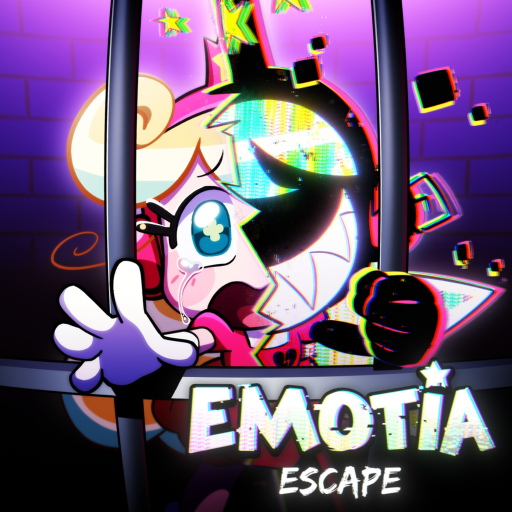
EMOTIA Escape Corrupted Emotians Story and Enemy Guide Wiki
Read the EMOTIA Escape Corrupted Emotians story, their verified role in the Emotion Prison, why their cute appearance misleads, and what remains unknown.
What Corrupted Emotians are
The EMOTIA Escape Corrupted Emotians story begins with dangerous inhabitants taking over the Emotion Prison. The official Roblox description gives them three clear functions: they occupy the central setting, they create a growing threat as players move deeper, and they are targets of the player's cleansing objective. That is enough to understand their place in the game without inventing a full enemy catalogue.
Their name links them directly to the game's emotion-based afterlife premise. However, the approved source does not explain the exact origin of the corruption, whether it affects every Emotian in the same way, or whether cleansing defeats, restores, or transforms a particular individual. “Cleanse” is the official objective word, so this guide preserves it while leaving the unconfirmed mechanism open.
The official copy also warns players not to trust adorable appearances. Promotional art reinforces a contrast between colorful, expressive characters and shadowy or distorted threats. Artwork can establish the intended tone, but it should not be used alone to name an ability or claim a specific encounter. The dependable conclusion is narrower: cute presentation does not make later dangers harmless.
Check the official Roblox experience before classifying an encounter. A publishable entry should record:
- the current in-game or creator-owned name;
- the visible room or mission context;
- the observed behavior and review date.
The threat they create inside the prison
The official description connects deeper progression with increasingly dangerous threats and intense chases. That makes Corrupted Emotians part of the pressure that changes exploration into survival. Players are not merely reading environmental clues; they must continue working through puzzles and missions while danger escalates.
It is important not to turn that broad statement into a fabricated behavior sheet. The collected official text does not publish detection ranges, movement speeds, damage values, spawn odds, chase timers, counters, or floor-specific identities. A community walkthrough may visibly demonstrate an encounter in one server, but a reliable wiki should record the build and observation before converting it into a stable instruction.
For practical play, the evidence supports an observation-first approach. When a threat appears, note the current room, visible warning, path options, and what starts or ends the chase. Change only one part of the next attempt. That is a general verification workflow, not a claim that every enemy follows the same rule. It helps players learn the current build without pretending an unsupported universal mechanic exists.
| Question | Verified answer | Evidence boundary |
|---|---|---|
| Where are they? | They have taken over the Emotion Prison | No complete floor-by-floor location list |
| Are they dangerous? | Yes; later threats become increasingly dangerous | No official numeric danger scale |
| Why do they look cute? | The description deliberately contrasts appearance and danger | No confirmed rule tying appearance to abilities |
| What must players do? | Cleanse Corrupted Emotians while pursuing prison missions | The exact cleansing procedure is not documented |
| Is every enemy identified? | No complete official roster is in the approved source | Video labels require current-build verification |
Cleansing is the mission, not a published formula
The player's wider objective is to restore peace, and cleansing Corrupted Emotians is part of that mission. This wording suggests the encounter has narrative importance beyond simply avoiding a monster. Still, the source does not define a universal cleanse button, item cost, sequence, or success rate. Publishing one would risk transferring a temporary interface detail or a mechanic from another game.
Missions, customization, and upgrades are all verified features in the official description. They may support deeper progression and repeated attempts. What the evidence does not establish is a direct formula between a particular upgrade and a particular Corrupted Emotian. Players should read the current mission prompt and compare any upgrade effect in the live server rather than relying on an undated table.
Teams of up to five are advertised, and single-player is also supported. In a group, players can communicate about visible threats and puzzle information, but the source does not assign fixed combat, support, or puzzle roles. A safe cooperative routine is to call out what is observed, keep the next objective clear, and avoid presenting player-created roles as canon.
The same caution applies to “best character” claims. Customizable characters are real, yet the approved evidence does not provide a current roster, stats, or ranking basis. A character image can help with recognition; it cannot by itself support an optimal pick or enemy counter.
How to verify an enemy entry
A high-quality enemy entry needs more than a screenshot. Record the exact experience and place ID, the date and game label, the displayed enemy name if one appears, the room or mission context, the visible trigger, the observed behavior, and whether the result repeated. Separate a direct observation from an interpretation of why it happened.
Use the official experience at place ID 136309958558481 as the identity check. The developer is the Roblox community EMOTIA x VERSEWORK. If a clip belongs to another similarly styled delver or horror experience, it cannot fill a gap here. Likewise, an edited thumbnail is promotional context rather than proof of an in-game name.
Update-sensitive details deserve a date. The official page was recorded as updated on August 1, 2026 and still carried the BETA label. A later build may add or alter encounters. When two observations disagree, prefer the current live prompt and preserve the older statement only as dated history if it remains useful.
This verification standard deliberately produces a smaller list. The benefit is that players can distinguish a confirmed role from a convenient fan label and a current observation from an alleged permanent rule.
Reading appearance without inventing lore
EMOTIA Escape uses strong visual contrast. Colorful characters, expressive faces, flowers, stars, and toy-like spaces can sit beside dark silhouettes, glowing mouths, and chase imagery. The official warning supports the emotional effect of that contrast: something that looks adorable may still be dangerous.
It does not confirm that every color maps to a named emotion, that every accessory signals a power, or that every monster was once a specific character. Those can be reasonable subjects for community theory, but they should be labeled as theory. Official names, biographies, transformations, and relationships require a developer-owned statement or unambiguous current-game text.
Players can still use visual information responsibly. Describe what is plainly visible, such as a silhouette, expression, location, or warning animation. Avoid turning the description into a statistic or backstory. If the game later publishes a bestiary or character profile, that creator-owned source can replace provisional visual labels.
FAQ
What are Corrupted Emotians?
They are the dangerous beings that have taken over the Emotion Prison. Players face them while venturing deeper and are tasked with cleansing them as part of restoring peace.
Why are Corrupted Emotians dangerous?
The official description says threats become increasingly dangerous and includes intense chases. It does not provide official damage, speed, or detection values.
Is there a complete enemy list?
Not in the approved official evidence. Community videos can show encounters from particular builds, but names, rooms, and behaviors need current in-game or creator-owned confirmation.
Does cleansing mean destroying an Emotian?
The source uses “cleanse” but does not explain the outcome or mechanism. A claim that every target is destroyed, restored, or transformed would currently be speculative.